
Owner Education / Off-Island Owners
The Mainland Owner's Guide to Renting Out a Home on Oʻahu
What changes when you manage an Oʻahu rental from the mainland
The short answer
You can own and rent out an Oʻahu home while living anywhere in the country. The challenge is not ownership from a distance. It is making sure someone on island can act when the property, the tenant or the law requires it. Hawaii's Residential Landlord-Tenant Code takes the same view. It does not ask the owner to live here, but it does require an absentee landlord to designate an agent to act on the owner's behalf, and that agent must reside on the same island as the rental unit.
Most owners who call us from the mainland have already settled the big questions. They know roughly what the home should rent for, they have decided to hold it rather than sell, and they are comfortable with a tenant living in a house they love. What they have not usually mapped is the part that actually breaks: how the property operates when the owner is five or six time zones away. Who receives the notice. Who is standing in the kitchen when the water heater fails. Which decisions can wait for a reply from Denver, and which ones cannot.
This is a guide to that operating layer. Rather than repeat our broader guidance on renting out a home in Honolulu, it sets out what changes because you are not on island, and what to decide before your first tenant moves in.
Key takeaways
- An absentee landlord must designate an agent who resides on the same island as the unit, so an Oʻahu rental needs an Oʻahu agent.
- Your tenant must be given in writing, and kept current, the name and address of the owner or the agent authorized to receive rent, notices and demands.
- Habitability repairs carry three business days to take steps to start them, counted from your tenant's notice, not three business days to finish.
- Within 14 days of the tenancy ending, you must give the tenant written itemized notice of anything retained from the security deposit, with receipts, along with the balance.
- General excise tax is calculated on the total rent your tenant pays, not the net that reaches your mainland account.
- You can hire someone to prepare and file your returns, but the Department of Taxation still holds you responsible for filing and paying on time.
What travels, and what has to be local
The most useful question an off-island owner can ask is not what management costs. It is which parts of ownership survive the distance. A great deal of it does. Some of it does not, and pretending otherwise is how owners end up making a 5,000 mile round trip to meet a plumber. Sort the two before you sign anything.
Travels well
- Pricing and renewal decisions. These are judgment calls made from data, and data moves. See our notes on pricing a Honolulu rental and on what Hawaii requires when you raise rent.
- Approving scopes and budgets. Provided the estimate is specific and the photographs are good.
- Reviewing statements and filings. Reading is not location-dependent.
- Signing. Electronic signature has quietly solved most of what once needed a notary and a flight.
- Setting standards. Screening criteria, maintenance thresholds, pet policy. Write them down once and apply them consistently and they work at any distance. Consistency is also what keeps you on the right side of fair housing.
Does not travel
- Receiving notices and accepting service. This is the statutory core of the agent requirement.
- Being at the property. Move-in, move-out, an inspection, a vendor who needs a door opened.
- Keys, fobs, parking cards and mailbox keys. Small objects, disproportionate consequences.
- The first hour of an emergency. Shutting off water is not a conference call.
- Knowing a vendor will actually show up. A bench of trades that answers is local knowledge, and it is the subject of our piece on the five-handyman problem.
Everything in the second list resolves to one requirement: a capable person on Oʻahu. Hawaii's landlord-tenant law reaches the same conclusion, and writes it down.
What Hawaii asks of an owner who lives somewhere else
Chapter 521 of the Hawaii Revised Statutes cares less about where an owner lives than about whether the tenant has a person they can reach. Two separate requirements do that work, and owners routinely collapse them into one.
Designation. The Office of Consumer Protection's Residential Landlord-Tenant Handbook states it plainly under section 43: "An absentee landlord shall designate an agent to act on the landlord's behalf. The agent must reside on the same island as the rental unit." Not in the state. On the island. A trusted contact on Maui does not satisfy it for an Oʻahu rental.
Disclosure. Your tenant must separately be given, in writing, the name and address of the owner or the agent authorized to receive rent, notices and demands, kept current at all times. Skip it and the person who rented to the tenant becomes responsible for all of the landlord's obligations under the Code. Fail to disclose within ten days of a proper demand and you owe the tenant $100 plus attorney's fees. Landlords also have to give tenants their general excise tax number, for the low-income renter credit.
The handbook does not say the designation itself has to appear in the rental agreement. Putting both in the lease is simply the cleanest way to prove you did them, and it is what we do. That is good practice, not the statute talking.
Agent is not the same as manager
The Code asks for an agent who resides on the island. It does not, by itself, require a licensed management company. Licensing law is a separate question: managing real estate for others for compensation, as a whole or partial vocation, falls within Hawaii's statutory definition of a real estate broker, and chapter 467 requires a license for it. That chapter lists exceptions, including an owner and an individual acting under a power of attorney from the owner. So an unpaid family member can serve as your designated agent. Whether they should is mostly a question about what happens on a Saturday night, which our guide for military families, renting out a Hawaii home after PCS orders, takes up.
The clocks that run on Hawaii time
This is the part distance genuinely changes. Several of the Code's deadlines do not begin when you learn something. They begin when your tenant acts, or when a tenancy ends, and they keep running while you are asleep three or six time zones away.
| What starts the period | How long you have | Source |
|---|---|---|
| Tenant reports a habitability problem | 3 business days to start repairs | Section 64(c) |
| The tenancy ends | 14 days to itemize and return the balance | Section 44(c) |
| Tenant demands disclosure | 10 days, then $100 plus fees | Sections 43, 67 |
| You need non-emergency access | At least 2 days notice | Section 53(b) |
| You end a month-to-month tenancy | 45 days written notice | Section 71 |
| A GET filing period closes | Due the 20th of the next month | Dept. of Taxation |
The deposit row catches off-island owners most reliably, because the failure mode is postal rather than legal. Within 14 days of the rental agreement terminating, the tenant must receive written notice of the reasons for any retention, with costs itemized and receipts included, plus the remaining balance. Estimates may stand in where repairs cannot be finished in time, and mailing on or before the fourteenth day complies, so keep proof of mailing. If notice and the balance are not accomplished within 14 days, the handbook is unambiguous: the entire deposit must be returned to the tenant.
Now picture the off-island version of that sequence. The tenant moves out, keys are dropped with someone, photographs are taken at some point, an invoice is requested, forwarded, reviewed and approved, and a check is cut on the mainland and mailed back to Hawaii. That chain has consumed 14 days more than once. Our guide to the 14-day rule has the mechanics. The fix is structural: the itemization and the funds have to be prepared by someone on island who already holds the photographs.
When something fails at 2 a.m. Hawaii time
The legal floor is three business days from the tenant's notice to take steps to start repairs needed for sanitary and habitable living conditions, which includes major appliances and electrical, plumbing and other necessary facilities. That is three business days to begin, not to finish. Repairs must then be completed as soon as possible in good faith, and if you cannot start in time for reasons beyond your control, you have to tell the tenant why and set a reasonable tentative start date.
If the landlord fails to perform the repairs, the tenant may have them done and, on providing copies of all receipts, deduct up to $1,000 or one month's rent, whichever is greater, from the next month's rent. That is a meaningful number against an Oʻahu rent, and it is your tenant's decision, using a contractor you did not select.
Three business days is the floor, not the standard. What protects an off-island owner is a structure decided in advance: a named person on island who can make a call without waking you, a written spending authority so routine repairs do not wait on an approval email crossing a time zone, and a vendor bench that answers the phone. Set the authority limit deliberately. Too low and every broken disposal becomes a transpacific negotiation. Too high and you have stopped exercising judgment about your own asset.
Seeing a property you cannot see
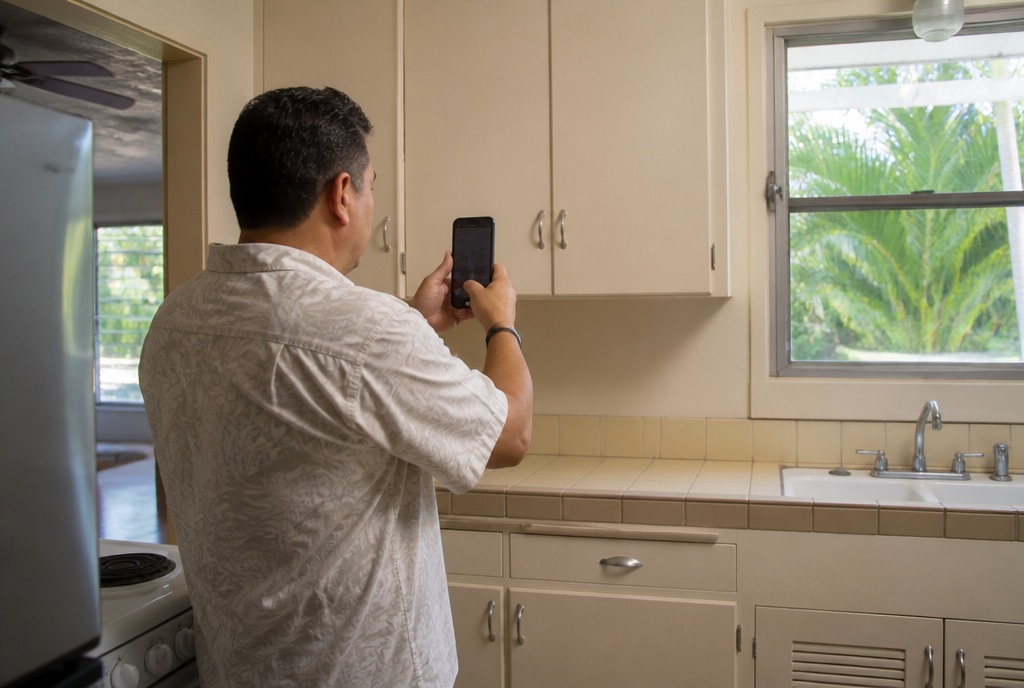
An owner on island forms an impression of a property incidentally, by driving past it. An owner in Seattle has only what someone chose to record. Documentation is therefore not an administrative nicety, it is the entire evidentiary basis of the tenancy.
Three things are worth insisting on. A move-in condition record with dated photographs of every room, agreed with the tenant. Periodic interior inspections on a stated cadence, each producing photographs rather than a summary paragraph. And a move-out record in the same format as the move-in one, so the comparison is like for like. The connection to the deposit deadline is direct: you cannot itemize a deduction you cannot evidence, and deposit disputes are decided in small claims court, where lawyers are not allowed to represent either party.
Access is regulated. Except in an emergency, the landlord must give the tenant at least two days notice and, with the tenant's approval, may enter only during reasonable hours. Set the inspection cadence out in the lease and schedule it properly, rather than springing it on a tenant because an owner is visiting next week. Our notes on maintaining a rental property cover the preventive side.
Register before the first rent arrives
The Department of Taxation's position is unambiguous: if you receive rental income from residential real property located in Hawaii, you are engaging in a taxable business activity. That is true of a whole house, a condominium, a second home or a single room, and true even if your tenants are relatives. So registration comes first, on Form BB-1, filed through Hawaii Tax Online or by mail, followed by periodic returns on Form G-45 and an annual return on Form G-49.
The filing mechanics have their own article. Filing frequency, due dates, the electronic filing threshold and the arithmetic of the rate are set out in our guide to GET tax filing, and the state's own detail is in the Department of Taxation's brochure on renting residential real property. For the wider picture, see Hawaii rental property taxes and Honolulu property taxes for rental owners.
Two points are specific to a mainland owner. A nonresident or part-year resident individual reports net rental income or loss on Form N-15, and you must file a Hawaii income tax return whether the rental makes a profit or a loss. Because GET is calculated on gross rental income, a loss year does not remove it either. Transient accommodations tax is not your obligation on a standard long-term Oʻahu tenancy, since TAT reaches accommodations rented to a transient person for less than 180 consecutive days.
Your agent receiving rent counts as you receiving it
This is the piece genuinely distinctive to owning from a distance, and the most common tax error we see in off-island owners.
Start with the base. If your managing agent collects $1,000 of rent, deducts a $100 management fee and sends you $900, the general excise tax is calculated on $1,000. The fee is an expense of doing business, not a deduction or exemption for GET, and the same goes for repairs, interest, utilities, real property taxes and insurance.
Then the date, which is less intuitive. You report the income based on when your managing agent receives the rent, not when the disbursement reaches you. Because you authorized the agent to collect on your behalf, the Department of Taxation treats your tenant paying the agent as your tenant paying you. If your statement arrives weeks after the rent did, your reporting date has already passed, and penalty and interest are assessed on late returns.
Delegating the work does not move the obligation
On whether a management agreement shifts the responsibility, the Department of Taxation answers directly: "You are responsible for filing your tax returns and paying your taxes on time even if you hire someone else to do it for you." That is not a reason to avoid hiring help. It is the reason to ask any prospective manager, before you sign, what date owner statements are issued and what date filings are made. An agent who collects rent for you must also file the first page of your rental collection agreement, or federal Form 1099-MISC, with the Department, and tell you it has been done.
Deciding how involved to actually be
Some owners want to approve every decision from the mainland. Others prefer very little involvement. Both can work. The better approach is to decide in advance which decisions genuinely benefit from your input and which are better handled locally, rather than discovering the answer during an emergency.
So the useful question is narrower than "should I self-manage." It is: which decisions improve when I am in them, and which only get slower? Pricing, renewal strategy, capital spending and the standards you set improve with your attention. Dispatching a plumber does not improve because an owner in Chicago reviewed it first, it only happens later. We wrote about that pattern in why over-involved owners often earn less, and it is sharper at distance.
Choosing representation for the first time? Our guide to what owners should look for in a Honolulu management company sets out the questions worth asking, and changing managers on Oʻahu covers the case where you already have one and it is not working. For the rules underlying any Hawaii tenancy, start with the Hawaii landlord-tenant law overview and the state's own Office of Consumer Protection resources.
Common questions
Can I rent out my Hawaii home if I live on the mainland?
Yes. Hawaii does not require a rental property owner to live in the state. It does require someone to be here on your behalf. Under the Residential Landlord-Tenant Code, an absentee landlord must designate an agent to act on the landlord's behalf, and that agent must reside on the same island as the rental unit. Separately, your tenant must be given in writing the name and address of the owner or the agent authorized to receive rent, notices and demands, and that information must be kept current.
Does Hawaii require an out-of-state owner to hire a property manager?
Not in those words. The Code requires an agent who resides on the same island as the unit. It does not name a licensed management company. What licensing law adds is separate: managing real estate for others for compensation falls within Hawaii's statutory definition of a real estate broker, so a paid manager generally needs a license. Chapter 467 does list exceptions, including an owner and an individual acting under a power of attorney from the owner. The question worth asking is not who is cheapest, but who can receive a legal notice and be at the property the same day.
Do I need a GET license to rent out my house on Oʻahu?
Yes. The Department of Taxation treats renting out residential property in Hawaii as a taxable business activity, so you register for the general excise tax before you start collecting rent. Registration is Form BB-1, which can be filed through Hawaii Tax Online, and the GET registration fee is $20. You then file periodic returns on Form G-45 and an annual return on Form G-49. Our guide to GET tax filing covers the mechanics in detail.
Do I have to file a Hawaii tax return if my rental loses money?
Yes. The Department of Taxation is explicit that you must file a Hawaii income tax return whether you have a profit or a loss from your rental business. A nonresident or part-year resident individual files Form N-15. A loss does not remove the filing obligation, and it does not remove the general excise tax either, because GET is calculated on gross rental income rather than on profit.
How quickly do I have to respond to a repair request if I live on the mainland?
The Code gives the landlord three business days to take steps to start repairs that are necessary for sanitary and habitable living conditions, counted from when the tenant notifies you, orally or in writing. That is three business days to begin, not to finish, and there is a good faith requirement that repairs be completed as soon as possible. The period runs from your tenant's notice, not from when the message reaches your time zone. If the landlord fails to perform the repairs, the tenant may have them done and, on providing receipts, deduct up to $1,000 or one month's rent, whichever is greater, from the next month's rent.
Is the general excise tax calculated on the rent I receive after management fees?
No. GET is owed on the total rent paid by the tenant, not the net amount that reaches you. The Department of Taxation gives the example directly: on $1,000 of rent with a $100 management fee, the tax is calculated on the full $1,000, because the management fee is an expense of doing business rather than a deduction. Timing follows the same logic. You report the income when your managing agent receives the rent, not when the disbursement lands in your mainland account.
Own a home on Oʻahu and live somewhere else?
We manage long-term residential rentals across Oʻahu. Many of the owners we work with live off island, so our systems are built around keeping owners informed without requiring them to be here. If you would like a view on what your property would let for, and an honest read on what the off-island version of owning it actually looks like, we are glad to take a look. Our management fees are set out on our pricing page, and if you are still deciding who should represent you, our guide to choosing a property management company in Hawaiʻi sets out what to ask.
This article describes Hawaii's Residential Landlord-Tenant Code and Department of Taxation guidance as they stood in September 2026, and is general information for rental property owners, not legal or tax advice. Statutory descriptions follow the Office of Consumer Protection's published Residential Landlord-Tenant Handbook and chapter 521 of the Hawaii Revised Statutes; licensing descriptions follow chapter 467 as published by the Real Estate Branch; tax descriptions follow the Department of Taxation's published guidance on renting residential real property. Condominium and cooperative bylaws, community association rules and any subsidized housing program may impose further requirements. For a specific situation, particularly one involving a disputed deposit, a habitability claim or your own tax position, consult a Hawaii attorney or tax professional.


