

Owner Education / Hawaii Rental Law
How Much Can a Landlord Raise Rent in Hawaii?
The 2026 rules on amount, notice and timing
There is no cap on the amount. There are firm rules on the notice, and getting the count wrong is what actually costs owners money.
The short answer
Hawaiʻi does not limit how much you can raise the rent. There is no percentage cap and no rent control anywhere in the state, so the amount is whatever you set and your tenant accepts. What the law does control is when. For a month-to-month tenancy you must give 45 consecutive days of written notice before the higher rent takes effect. For a tenancy shorter than a month it is 15 consecutive days. During a fixed-term lease you cannot raise it at all unless the lease itself says you can. And you cannot raise it in response to a tenant's good-faith complaint or repair request.
Key takeaways
- No cap on the amount. Hawaiʻi has no rent control and no percentage limit. The market sets the ceiling, not the statute.
- 45 days' written notice, month to month. Counted backwards from the day the new rent starts, not from the day you decide.
- 15 days if the tenancy is shorter than a month. That is the rule covering week-to-week arrangements.
- A fixed-term lease is fixed. No unilateral increase during the term unless the lease contains its own escalation clause.
- Timing can void an increase. Short notice, or an increase that follows a repair complaint, and the old rent simply continues.
Almost every owner who asks this question is really asking two questions at once, and the answers point in opposite directions. How much is barely regulated in Hawaiʻi. How and when is regulated closely enough that an otherwise reasonable increase can fail on a technicality and cost you two months of the difference.
So it is worth separating them.
How much: there is no limit
Hawaiʻi is not a rent-control state. No statute caps the size of a rent increase, no percentage ceiling applies, and there is no statewide rent stabilization program. The Residential Landlord-Tenant Code takes the opposite starting point: HRS §521-21(a) says the landlord and tenant "may agree to any consideration, not otherwise prohibited by law, as rent."
In practice the limit is commercial rather than legal. Price above what comparable units are getting and you carry a vacancy, a turnover, and the cost of finding someone new. That arithmetic usually bites well before any statute would.
If your unit is in a program
Subsidized and affordable-housing units are a different matter. If your property is in a voucher program or carries an affordability covenant, that agreement sets its own rules on increases and approvals, and they override the general position described here. Check the program documents before you send anything.
How Much Notice Is Required: 45 Days or 15 Days
This is the part with teeth. The requirement depends entirely on what kind of tenancy you have.
| Type of tenancy | Notice required | Authority |
|---|---|---|
| Month to monththe common case | 45 consecutive days | HRS §521-21(d) |
| Less than month to monthincludes week to week | 15 consecutive days | HRS §521-21(e) |
| Fixed term, during the terma signed 12-month lease | No unilateral increase | Not provided for in ch. 521 |
The statute writes the second row as a tenancy "less than month to month" rather than naming week-to-week specifically. A week-to-week arrangement is the ordinary example of one.
Two details in the statutory wording do most of the damage when they are missed.
The notice must be written. A conversation on the lanai, a text message you did not keep, a voicemail: none of these start the clock in a way you would want to defend.
And the days are counted backwards from the effective date, not forwards from the day you made the decision. §521-21(d) requires the notice to be given "forty-five consecutive days prior to the effective date of the increase." The date that matters is the first day the higher rent is due.
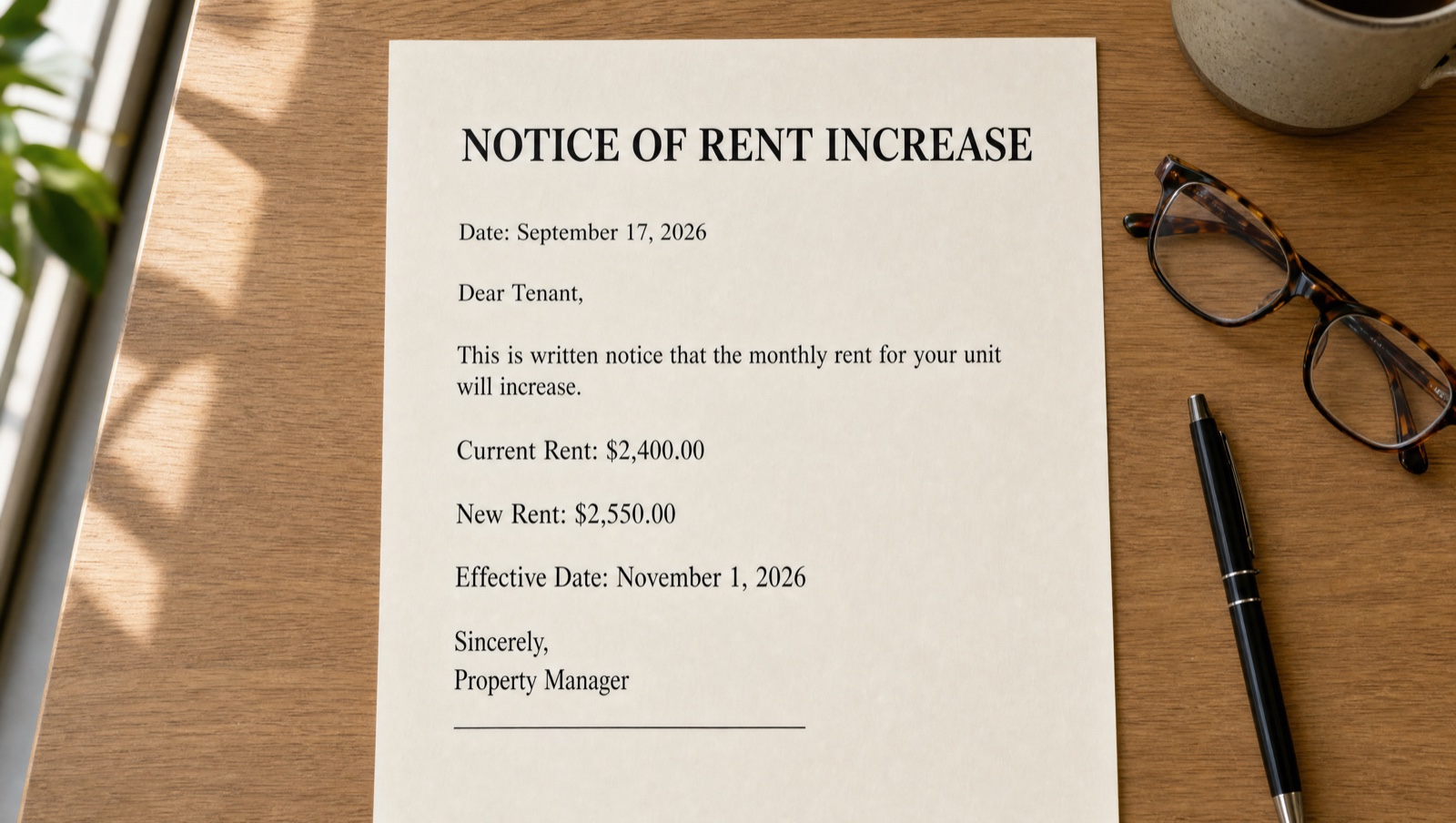
Counting the 45 days
Work backwards from the first day the new rent is due.
If you want the increase to take effect on November 1, forty-five days before that is September 17. If you want it on January 1, you are looking at November 17. Neither date is intuitive, which is exactly why owners get caught: a decision made in early October feels like plenty of warning for January, and it is, but a decision made in late November is not.
Give yourself a cushion. The statute does not spell out whether the day of delivery counts, and nothing is gained by finding out the hard way. A notice sent a week early costs you nothing. A notice sent three days late costs you the increase for that whole month, because the old rent continues until a properly noticed period has run.

During a fixed-term lease, the rent is the rent
If your tenant signed a twelve-month lease, you cannot raise the rent in month seven because the market moved.
The notice provisions above are written to apply "when the tenancy is from month to month" and "when the tenancy is less than month to month." A fixed term is neither. Chapter 521 gives a landlord no mechanism to change the rent during an agreed term, and §521-22 lets the parties agree in writing to any period they like as the term. Having agreed it, you are both held to it.
The exception is a lease that provides for an increase itself, through a stated escalation or a scheduled step in year two. That clause governs because it was part of the bargain. If you want that flexibility, it belongs in the lease at signing, not in a letter halfway through.
When a fixed term ends without a new lease, the tenancy usually continues month to month, and the 45-day rule applies from then on.
When you may not raise the rent at all
Separately from timing, HRS §521-74 bars a landlord from demanding a rent increase in retaliation. The bar applies after any of three things has happened:
- The tenant has complained in good faith to the Department of Health, to you, to the building department, to the Office of Consumer Protection or to another agency, about a condition that violates a health law or the Landlord-Tenant Code.
- An agency has filed a notice or complaint of such a violation.
- The tenant has requested repairs in good faith under §521-63 or §521-64.
The same section prohibits evicting the tenant or cutting back services in those circumstances, and a tenant who is unlawfully dispossessed can recover damages, costs and reasonable attorney's fees.
This does not freeze your rent forever. §521-74(d) lists five situations in which an increase is still permitted, and two of them come up in ordinary practice:
- Costs genuinely went up. You became liable for a substantial increase in property taxes, or in other maintenance or operating costs unconnected to fixing the complaint, at least four months before you demand the increase, and the increase does not exceed the prorated share of that net rise. Property taxes are the common trigger, and if the property recently converted from owner-occupied to rental, the county side of that shift is set out in our guide to what happens to your Honolulu property taxes when you rent out your home.
- The rent is simply at market. You can establish by competent evidence that the rent now demanded does not exceed what other tenants pay for similar units in the same building, or, for a single-family home, does not exceed market rental value.
The remaining three cover a Department of Health certification of compliance, a completed capital improvement capped at straight-line depreciation prorated among the units that benefit, and a complaint about a condition the tenant caused through want of due care.
Retaliation is one corner of a larger code. Our guide to Hawaii landlord-tenant law covers the rest of chapter 521, including entry, repairs and ending a tenancy.
The practical lesson is about sequence rather than prohibition. An increase that lands two weeks after a tenant reports a plumbing failure invites an argument you did not need to have, even when your reasons are sound. Fix the problem, document the fix, and let the increase stand on its own footing.
Three traps worth knowing
You cannot terminate your way around the notice
§521-71(f) is blunt about it: any notice of termination initiated for the purpose of evading the landlord's obligations under §521-21(d) or (e) "shall be void." Ending the tenancy to reset the rent, when the real object is the rent, does not work.
A holdover reverts to the old rent
If a tenant stays past the end of a tenancy and you do not begin summary possession proceedings within the first sixty days, §521-71(e) provides that a month-to-month tenancy at the rent stipulated in the previous agreement takes over. Waiting does not raise the rent. It fixes it at the old figure.
The deposit ceiling moves with the rent
§521-44(b) caps a security deposit at one month's rent, with a separate pet deposit also capped at one month's rent. Because the cap is expressed as a month's rent rather than a fixed sum, a higher rent raises the ceiling. Whether you may collect the difference part-way through a tenancy is a question for your lease and your attorney. Our guide to Hawaii security deposit law covers the cap in full, and our note on the 14-day rule for returning deposits covers the other end of that relationship.
Is Hawaiʻi about to get a rent cap?
Not from the 2026 session.
Two companion bills, SB2539 and HB2105, were introduced in January under the title "Relating to Rent Stabilization." Both would have established a statewide 3 per cent annual limit on rent increases under chapter 521, barred any increase during the first twelve months of a tenancy, and required notice and certification for exempt properties.
Both were referred to committee on January 28, 2026. Neither was ever scheduled for a hearing. The Legislature's own measure pages record no committee reports and no testimony for either bill, and neither advanced past that referral. They did not become law.
It is a recurring proposal rather than a settled question, so it is reasonable to expect something similar in a future session. Nothing about it changes what applies to your property today.
A sensible sequence for raising the rent
- Check what kind of tenancy you actually have. Month to month, or still inside a fixed term? Everything else follows from this, and owners are wrong about it more often than you would expect.
- Price it against real comparables. There is no legal ceiling, so the only discipline is the market. An increase that triggers a turnover rarely pays for itself once vacancy and make-ready are counted.
- Pick the effective date first, then count back 45 days. Add a cushion.
- Put it in writing and keep proof of delivery. State the current rent, the new rent, and the exact date it takes effect.
- Check the last few months for open complaints or repair requests. If there are any, deal with them first and be able to show why the increase stands on its own.

If you are weighing a first increase on a property you have not raised in a while, it usually helps to look at the whole position rather than the rent alone: what the unit would actually let for today, what turnover would cost, and what has happened to your outgoings. Owners newer to renting on Oʻahu may find our guide to renting out a home in Honolulu and our overview of Hawaiʻi rental property taxes useful background, and owners renting out a home after a move are covered in our guide for military families renting out a home during a PCS.
Common questions
How much can a landlord raise rent in Hawaiʻi?
There is no legal limit on the amount. Hawaiʻi has no statewide rent cap and no rent control, so the size of an increase is whatever the landlord sets and the tenant accepts. The law regulates the timing instead: 45 consecutive days' written notice for a month-to-month tenancy under §521-21(d), and 15 consecutive days' notice for a tenancy shorter than month to month under §521-21(e).
Is there rent control in Hawaiʻi?
No. Hawaiʻi has no statewide cap on rent increases. Two 2026 bills, SB2539 and its companion HB2105, would have created a 3 per cent annual limit and barred any increase in the first 12 months of a tenancy. Both were referred to committee on January 28, 2026, never received a hearing, and did not become law.
How much notice does a landlord have to give to raise rent in Hawaiʻi?
Forty-five consecutive days in writing before the higher rent takes effect, for a month-to-month tenancy. For a tenancy shorter than month to month, which is what a week-to-week arrangement is, the requirement is fifteen consecutive days. Count backwards from the date the new rent starts, not from the date you decide on it.
Can a landlord raise rent during a fixed-term lease in Hawaiʻi?
Not unilaterally. The notice rules in §521-21 apply to month-to-month tenancies and shorter, and nothing in the Residential Landlord-Tenant Code lets a landlord change the rent during an agreed term. For the length of the lease the rent is the rent the lease sets. The exception is a lease that contains its own escalation clause, in which case that clause governs.
Can a landlord raise rent after a tenant complains about repairs?
Usually not. §521-74 bars a landlord from demanding a rent increase after a tenant has complained in good faith to a government agency or to the landlord about a condition that violates a health law or the Landlord-Tenant Code, or has made a good-faith repair request under §521-63 or §521-64. The statute then lists five narrow circumstances in which an increase is still permitted, including a substantial rise in property taxes or operating costs incurred at least four months before the demand.
What happens if a rent increase notice is short?
The increase does not take effect on the date named. The tenant continues to owe the old rent until a properly noticed 45-day period has run. Reissuing the notice correctly is the fix, and it costs the owner the difference for those weeks.
Not sure what your unit should be renting for?
We manage long-term residential rentals across Oʻahu, and pricing a renewal is one of the judgment calls we make most often. If you would like a view on what your property would let for today, and whether an increase is worth the turnover risk, we are happy to take a look. Our management fees are set out on our pricing page, and if you are still choosing a manager, our guide to choosing a property management company in Hawaiʻi sets out what to ask.
This article describes Hawaiʻi's Residential Landlord-Tenant Code as it stood on September 2, 2026, and is general information for rental property owners, not legal advice. Statutory text is quoted from the Hawaiʻi State Legislature's published version of chapter 521. Subsidized and affordable-housing units, and any lease with its own escalation terms, are governed by those agreements. For a specific situation, particularly one involving a disputed increase or a retaliation claim, consult a Hawaiʻi attorney.


